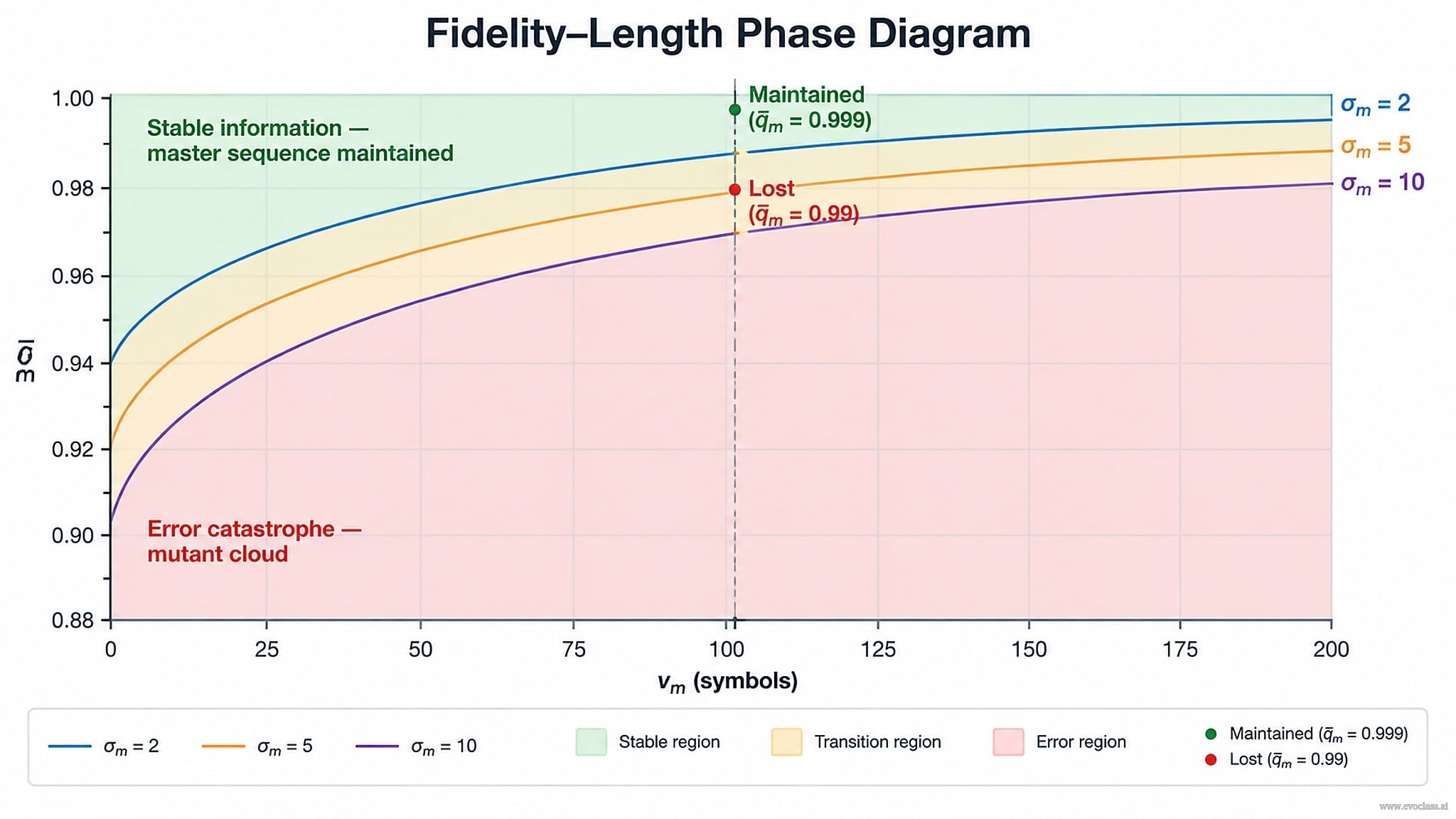
Molecular information is not automatically preserved. Replication, mutation, catalytic coupling, and selective advantage are specified properties of particular chemical systems, not global attributes of arbitrary matter. Once a replicating system exists, its ability to keep a meaningful sequence depends on a quantitative balance: the errors introduced during copying must be tolerated by the selective advantage that the meaningful sequence enjoys over its mutant cloud.
For a master sequence of length vₘ, mean per-symbol fidelity q̄ₘ, and selective advantage σₘ over the average mutant, the maintenance condition is
q̄ₘvₘ · σₘ > 1
Here q̄ₘvₘ is the probability that an entire copy is error-free, and it decreases exponentially as vₘ grows. The factor σₘ is the selective margin that tolerates the erroneous copies which are nevertheless retained. The error threshold is the boundary q̄ₘvₘ · σₘ = 1.
Reading the Threshold Relation
Rearranged, the boundary reads q̄ₘ > σₘ−1/vₘ. Fidelity, length, and selective advantage are therefore jointly decisive: none of them can be chosen independently of the other two.
- Mean fidelity q̄ₘ — the average probability of copying one symbol correctly.
- Sequence length vₘ — the number of symbols that must all be copied correctly.
- Selective advantage σₘ — how much faster the master sequence replicates than the average member of its mutant cloud.
Above and Below the Threshold
Above the threshold, selection localizes the population around the meaningful sequence: a stable quasi-species peak is maintained, and most individuals still descend from the master sequence. Below the threshold, the master sequence cannot be distinguished from its mutants; the population delocalizes into a broad mutant distribution and the encoded information is lost — the error catastrophe.
The transition is phase-transition-like. It separates an ordered, information-bearing state from a disordered mutant cloud rather than describing a gentle decline.
Why Length and Advantage Trade Off
Because q̄ₘvₘ is exponential in vₘ, longer sequences require exponentially higher fidelity. A larger σₘ instead permits a longer vₘ or a lower q̄ₘ. This trade-off constrains the length of early replicators: with realistic prebiotic fidelity, only short sequences could be maintained, which motivates higher-level organization such as hypercycles, in which several short replicators are linked into a jointly selected network.
Worked Example
Take vₘ = 100 and σₘ = 2. With q̄ₘ = 0.99, q̄ₘvₘ ≈ 0.366 and σₘ · q̄ₘvₘ ≈
Assumptions and Limits
The classical threshold assumes large populations, constant organization, and a single-peak fitness landscape. Finite populations, neutrality, compensatory mutations, and rugged landscapes smear the transition but do not remove the underlying constraint.
Fidelity–Length Phase Diagram
Threshold curves q̄ₘ = σₘ^(−1/vₘ) for σₘ = 2, 5, and 10 plotted against sequence length vₘ. Above a curve, selection localizes the population on the master sequence; below it, the population delocalizes into a broad mutant cloud. A larger σₘ lowers the fidelity needed at a given length, and the two marked points at vₘ = 100 show how changing q̄ₘ from 0.99 (lost) to 0.999 (maintained) crosses the boundary.